

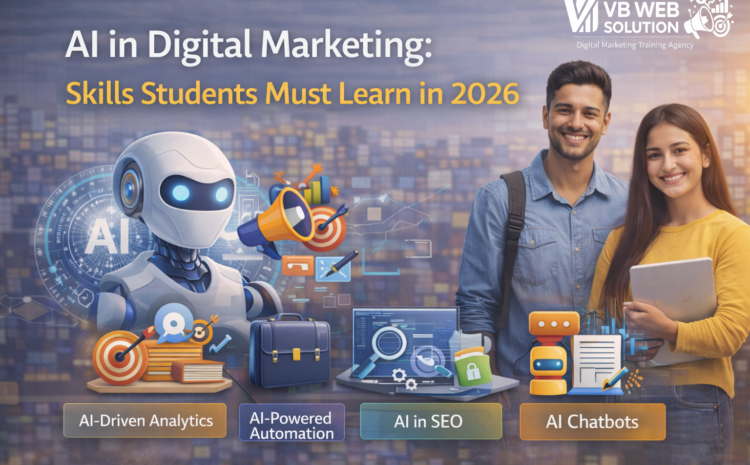
AI in Digital Marketing: Skills Students Must Learn in 2026
AI in Digital Marketing: Skills Students Must Learn in 2026
The conversation has officially shifted.
In 2024, everyone was asking, “Will AI take my job?” By 2026, we have the answer: AI isn’t taking your job, but a marketer who knows how to use AI is. Having spent twelve years watching the industry transition from basic social media posts to complex automated neural networks, I’ve never seen a more exciting—or more demanding—pivot point.
For students entering the fray today, the “standard” digital marketing toolkit is no longer enough. You are no longer just a “Content Writer” or an “Ad Manager.” You are an Architect of Systems. To survive and thrive, you need to master the intersection of human psychology and algorithmic intelligence.
Here are the non-negotiable skills for AI in digital marketing in 2026.
1. Advanced Prompt Engineering & Orchestration
If you think prompt engineering is just asking ChatGPT to “write a catchy caption,” you’re already behind.
In 2026, prompt engineering has evolved into Contextual Chaining. This is the art of building complex, multi-step workflows where AI handles the heavy lifting of data processing, while you provide the strategic guardrails.
Custom GPTs & Agents: Students must learn how to build “Digital Twins” or specialized AI agents that act as 24/7 brand experts.
Prompt Libraries: You should be building a personal “Source Code” of prompts that can generate high-converting landing pages, email sequences, and ad copy in seconds, not hours.
Refinement Logic: The skill isn’t in the first output; it’s in the iterative refinement. You must learn to “debug” an AI’s creative output like a developer debugs code.

2. GEO (Generative Engine Optimization)
SEO is no longer about “ranking #1 on Google.” It’s about being the “Top Reference” for AI.
The traditional search engine is being replaced by Generative Engines like Gemini, SearchGPT, and Perplexity. When a user asks an AI for a recommendation, the AI doesn’t give them a list of links; it gives them a synthesized answer.
The Skill: You need to learn how to optimize your content so that Large Language Models (LLMs) cite your brand as the authoritative source. This involves mastering structured data, “Information Gain” (providing new facts the AI doesn’t already know), and building high-authority brand mentions across the “Knowledge Graph.”
3. AI-Augmented Data Literacy
In 2026, we don’t look at dashboards; we talk to them.
Data is the fuel for AI, but most of that data is “noisy.” Students must move from being “data reporters” to “data interpreters.”
Predictive Analytics: Using AI to forecast trends before they happen. Instead of saying “What happened last month?”, you need to be able to use AI to say “What is likely to happen in the next 30 days?”
Natural Language Querying: Learning how to ask an AI to find patterns in 10,000 rows of customer data to identify which segment is most likely to churn.
Hallucination Detection: This is critical. You must be able to spot when an AI is “hallucinating” data points—a skill that requires deep domain expertise.
4. Multimodal Content Production
Text is just the beginning.
By 2026, “content creation” includes text-to-video, text-to-audio, and text-to-image workflows. Tools like Sora or Veo allow a single marketer to do the work of an entire production house.
The “Human Editor” Role: AI can generate 100 versions of an ad, but only a human can decide which one resonates with the target audience’s emotions.
Hyper-Personalization: Learning how to use AI to create 1,000 different video variations for 1,000 different customer segments, all with personalized names and offers.
AI Ethics: Understanding the legalities of AI-generated content. Who owns the copyright? Is it “fair use”? These are the questions that will define the senior marketers of the future.
5. The “Quiet” Superpower: First-Party Data Strategy
As third-party cookies have vanished, AI needs a different source of power: First-Party Data. The best AI in digital marketing strategy is useless without good data. Students must learn how to build “Consent-Based” marketing funnels. You need to know how to convince a user to give you their email or phone number in exchange for a personalized AI experience (like a custom recommendation bot).
6. 2023 vs. 2026: The Skill Gap
| Marketing Role | 2023 Standard Skill | 2026 AI-Augmented Skill |
| Content Writer | Keyword Research & Drafting | AI Orchestration & Brand Voice Alignment |
| SEO Specialist | Backlink Building & Alt Tags | GEO & Knowledge Graph Citations |
| PPC Manager | Manual Bidding & Ad Copy | AI Bidding Logic & Creative Strategy |
| Social Media | Hashtags & Posting Schedules | Community Management via AI Agents |
7. Expert Insight: The 80/20 AI Rule
I have managed teams through the rise of social media and the rise of mobile. The same rule always applies.
Veteran’s Tip: > AI will handle 80% of the “doing”—the writing, the coding, the data crunching. Your value lies in the 20%—the “thinking.” The strategy, the empathy, and the final “Yes/No” on a creative campaign is where the money is made. Don’t be a button-pusher; be the person who decides which buttons matter.
8. How to Build Your “AI Portfolio” in 2026
Don’t just say you know AI. Show me.
The Prompt Repository: Show a folder of complex prompts you’ve built that solved a specific business problem.
The AI Campaign: Document how you used an AI-first approach to reduce the cost of a lead by 40%.
The Technical “Fail”: Explain a time AI gave you a wrong answer and how you caught it. This proves your “Critical Thinking” is superior to the machine.
9. Conclusion: The Rise of the Marketing Architect
The future belongs to the “Integrators.”
AI in digital marketing is not about technical wizardry; it’s about using technology to be more human. The faster you can automate the boring, repetitive tasks, the more time you have to focus on the things that truly matter: creative strategy, deep consumer empathy, and ethical brand building.
The machine is ready. Are you?


Write a Comment